


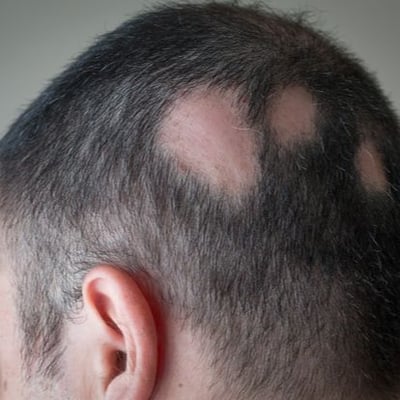
 Alopecia Areata
 Alopecia Areata
 Alopecia areata can develop suddenly over a few days or weeks. It can lead to unexplained hair loss, often in patches the sizes of coins. Today, around 6.8 million people suffer from alopecia areata in the United States. In addition, around half of them are males and white.
Alopecia areata is an autoimmune disorder that causes people to lose hair. Sometimes, it’s just a few spots, but the disease might lead to total hair loss as well. At times, hair does grow back. You may experience hair loss on your head or over your entire body. You may also experience hair thinning.
Causes
Alopecia areata forces your white blood cells to fight against the cells in your hair follicles.
As a result, the follicles suffer shrinkage and produce less hair. This leads to sudden hair loss that might extend for weeks.
Scientists aren’t sure what causes the white blood cells to attack the hair follicles. However, most patients have a family member who went through the same condition.
Therefore, genetics may have a part to play in the development of alopecia areata. Additionally, the disorder is related to vitiligo, where the skin loses its pigments in patches.
Usually, the condition affects people whose average age is 43.
Types
Patients may develop alopecia areata that starts with hair loss. The hair loss may not always remain limited to the head and spread to other body parts.
As a result, patients may have the following types of alopecia areata:
- Alopecia Areata: Alopecia means bald, and areata refers to patchy. You may lose hair from scalps, armpits, beards, and eyebrows.
- Alopecia Totalis: The whole scalp loses hair and turns bald when you have alopecia totalis.
- Alopecia Universalis: This is a rare condition where the whole body loses its hair.
Symptoms
Hair loss is a prominent symptom of alopecia areata. Patients may start to lose hair in sizes or a quarter that may progress to other areas. Additionally, they may lose hair from eyelashes, beards, and other body parts. The nails of fingers and toes can also be affected. Also, they may be affected first before the hair loss starts. Nails may lose shine, turn brittle, or become rough. You may also notice the appearance of white spots or lines. Moreover, the nails may become dented.
Treatment
Doctors don’t have a cure for alopecia areata at this moment. However, people who lose only a few patches of hair generally get better without any treatment.
For others, physicians may prescribe corticosteroids to inhibit the immune system. Patients may need to take them orally, through injections, or apply them as ointments.
In addition, doctors may recommend other medicines to encourage new hair growth like:
- DPCP
- Anthralin
- SADBE
- Minoxidil
Precautions
Patients may need to follow a few precautions if they lose hair due to alopecia areata. They include:
- Protecting exposed patches of scalp or skin with sunscreen
- Using a cap or hat to protect the scalp
- Wearing glasses to prevent debris falling into the eye due to missing eyebrows and eyelashes
